
On Building the Rights-Tech Engine Powering Music in Sport: A Conversation with Chantal Epp, Founder & CEO of ClicknClear

For this month’s CFFN Spotlight, we spoke with Chantal Epp, Founder & CEO of ClicknClear – a Cambridge company building the technology that makes global music licensing possible across performance sports.
Working with major record labels and music publishers, sports federations, and athletes in over a hundred countries, ClicknClear is pioneering a new category of rights-tech that transforms a fragmented, confusing legal process into a scalable global system. You’ll learn how the company is reshaping the infrastructure behind music rights in sport, why its approach is unlocking new revenue streams for artists, and how ClicknClear is redefining what compliance can mean for creative industries.
For those who haven’t come across ClicknClear yet, can you share what the company does?
ClicknClear is a rights-tech and licensing company solving copyright-infringement issues across sports such as dance, gymnastics, figure skating and cheerleading, where music is intrinsic to the routine.
The company began after Sony Music sued cheerleading for illegally editing and adapting music into mixes. At the time, I was working in music licensing but am also a two-time world champion cheerleader with a music-production company that made mixes for cheer and dance. I was perfectly placed to create a solution.
We now work with all the major record labels and publishers to clear the specialist set of rights needed, and with international sports federations to educate, license and check music usage. Our technology includes rights-management tools that handle complex music ownership, a licensing marketplace where athletes can instantly license tracks, and a license verification system that helps federations to check and manage copyright risk.
So you founded ClicknClear after seeing first-hand how difficult it was for cheerleading teams to license music. What broader problem did you see, and how did it lead you to focus on this space?
It all happened at once. I was working in music licensing for CueSongs, a company owned by Peter Gabriel, when it went into administration in 2016, the same week cheerleading announced that teams would need to start licensing any commercial music they used.
One day I lost my job. The next, I saw cheerleading facing a major copyright crisis. I knew from experience that teams could not license music easily, and that I was one of the few people who understood both sides of the problem.
After speaking to the lawyers representing Sony’s lawsuit, I realised this was not unique to cheerleading. Many sports such as dance, gymnastics and figure skating were using music in the same way, without a clear legal route. I started researching, talking to rightsholders about pricing and feasibility, and found the industry surprisingly open to working together. For labels and publishers, this was an untapped market: new revenue that expanded the pie rather than dividing it in a zero sum way.
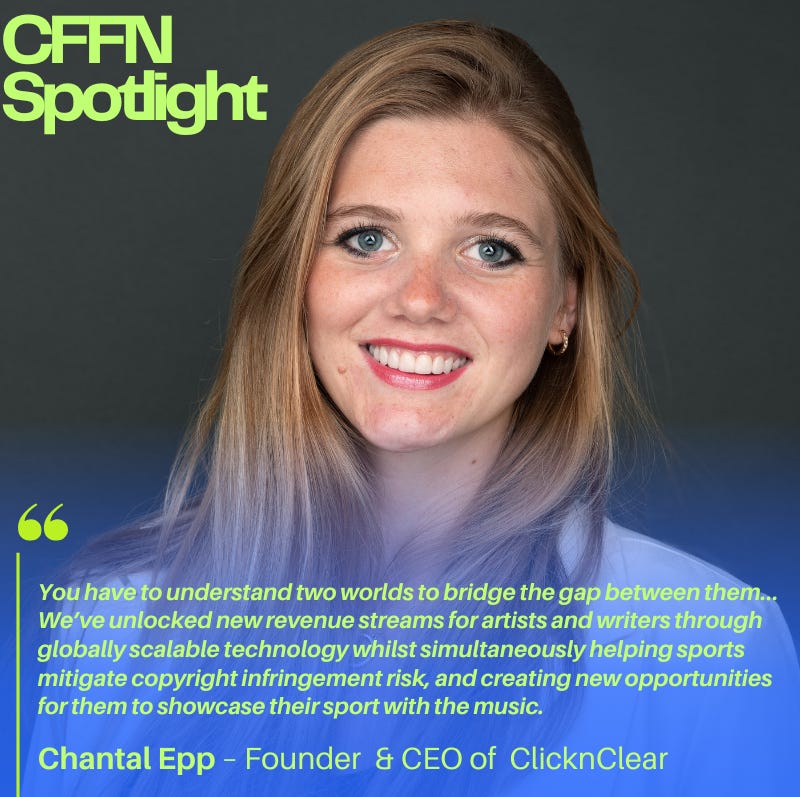
You have to understand two worlds to build the bridge between them. ClicknClear was born out of both a personal and an industry challenge, the right experience of both sport and music, and turned those into a scalable solution that helps the entire ecosystem grow.
This is a technically complicated space: music rights, royalties, clearances. How do you manage that level of complexity across so many territories?
I am very particular about music rights and data. The first thing we did was build a global rights-management database. Existing providers were expensive, so we built our own. That makes us unique: everything is developed in-house, which gives us full control and agility.
Through our contracts with music rightholders, we have direct data feeds (including all major record labels and music publishers). Every day, new music and ownership data flows into the platform. Our system ingests and matches label and publishing data to create a complete ownership picture, what we call a jigsaw puzzle of music rights. You have to find every single piece before you can sell the puzzle. Representation varies by country, so we store and match data territory by territory. Sometimes a track is available for license in one country, sometimes in 246.
Once the data is matched for given countries, it feeds into our licensing platform. When athletes license a track, we already know the ownership details and can pay every rightsholder accurately. Music does not go live unless it is 100%cleared on both the master and publishing sides. Ownership on the publishing side can be particularly fragmented.
We now manage around 50 million copyrights, of which 3.5 million are live. The rest are sat waiting for their missing puzzle pieces, which illustrates how fragmented music rights are.
Because we work with international sports federations, many connected to the Olympics, we had to think globally from the start, before moving into national markets. The sports are international, and so are the rightsholders. Everything, from our systems and licensing structure to our education for federations, was designed through that global lens.
What changed – technologically, culturally or regulatory – that made this model possible now, or that’s helping it grow today?
The music industry is becoming far more open to working with technology companies, and adopting technology within their workflows. There have been licensing start-ups before, but many were too early. By the time we came along, the industry was ready to scale into new areas and saw the value of modern streamlined micro-licensing models.
What makes us different is that we have secured full-catalogue deals with all major record labels and music publishers, which is rare. That may be because our technology gives them transparency and control.
AI has also played a role. The industry is still recovering from the technological disruption of the Napster era, and with AI creating new uncertainties, many rightsholders are looking for additional legitimate ways to monetise their music. What we offer is a structured, sustainable revenue stream in a space that has long been under-licensed.
How big is the gap you’re closing across sports, music and licensing? And how have partnerships with federations or rightsholders shaped your growth so far?
We estimate the overall market we are currently addressing at about $4.5 billion.
When we first started, we focused on licensing music for athletes, the tracks used in routines. Over the last few years, we have put the foundations in place to expand into video-on-demand, as sports are wanting to live-stream and distribute content online in this online age.
Federations want to grow digital engagement and participation, which means creating broadcast and on-demand content that reaches wider audiences. We have built what we believe is the first global video-on-demand licensing solution, made possible by our technology.
That effectively almost doubles our total market, from about $2.4 billion to $4.5 billion, by opening up new use cases. Every sport now wants its own digital channel, often subscription-based rather than on YouTube. It is a massive opportunity, and it is happening fast.
What kind of ecosystem – across technology, policy or culture – needs to exist around you for ClicknClear to scale globally and achieve that vision?
From a tech standpoint, we’re there. The systems are global and constantly improving.
From a policy perspective, music is governed by international copyright law and treaties set by the World Intellectual Property Organization (WIPO) plus local copyright laws set by each nation. We stay close to that landscape. Earlier this year, we won an award from WIPO for our innovation in and commercialisation of IP.
Some countries are more advanced in enforcing copyright law and there are some local differences, but we have shown we are able to still license music even in more challenging regions. One of our strengths is direct data access from labels and publishers, so we can match and license their catalogues in full compliance.
We have always chosen to address things in the right way, respecting music copyright owners at all times), because it is the only way to build something sustainable.
The biggest challenge is cultural. It is about shifting the mindset that “music is free.” People need to understand that music is intellectual property – someone created it, and using it requires permission and payment.
The encouraging thing is that sports federations already understand this. Many have faced lawsuits or cease-and-desist letters of demand, and now see compliance as essential. They are motivated to educate teams and enforce licensing rules, which creates a ripple effect.
We are showing people that licensing music does not have to be a bureaucratic nightmare. It is now simple and instant. We have removed the barrier to doing things the right way, and found that athletes have responded well.
Looking ahead, what shifts do you think your company will drive in how music and performance intersect over the next decade, once your model becomes the standard?
Sports will always be a vital part of society. AI can disrupt many markets, but it cannot replace humans participating in physical activity. People still love to play sport and need to exercise.
There is also a big push for women’s sports, both in participation and visibility, and for highlighting female-oriented or historically female-dominated sports. Choreographed sports such as gymnastics, figure skating, cheerleading and dance have always been dominated by women, and I think we will see those get much more attention in the next few years. That means more use of music, and more need for proper licensing.
We see our platform expanding across those sports, but also beyond sport entirely. There are other untapped markets where music is being used but not properly licensed. We have identified several and plan to apply our technology there too. Long term, we also plan to expand beyond music IP, as there are similar problems in other creative areas that we can solve with the same or similar infrastructure and approach.
We’re incredibly thankful to Chantal Epp for sharing the story behind ClicknClear – a pioneering Cambridge venture turning music rights and licensing from a compliance challenge into a global opportunity for success.
🔗 Learn more about ClicknClear here
🔗 Music Week: Women in Music Awards 2025 – Entrepreneur Winner
🔗 Yahoo Finance: ClicknClear Wins 2025 WIPO Global Award
The Cambridge Female Founders Network (CFFN) is a founder-led community amplifying ventures emerging from Cambridge’s innovation cluster. If you’re a female founder, or want to follow the companies shaping the future from Cambridge, join the network or follow us on LinkedIn.